


(This will be an American Branch only presentation)
http://www.chicagoswordshow.com/ (Click link to Chicago Sword Show page April 24-26)
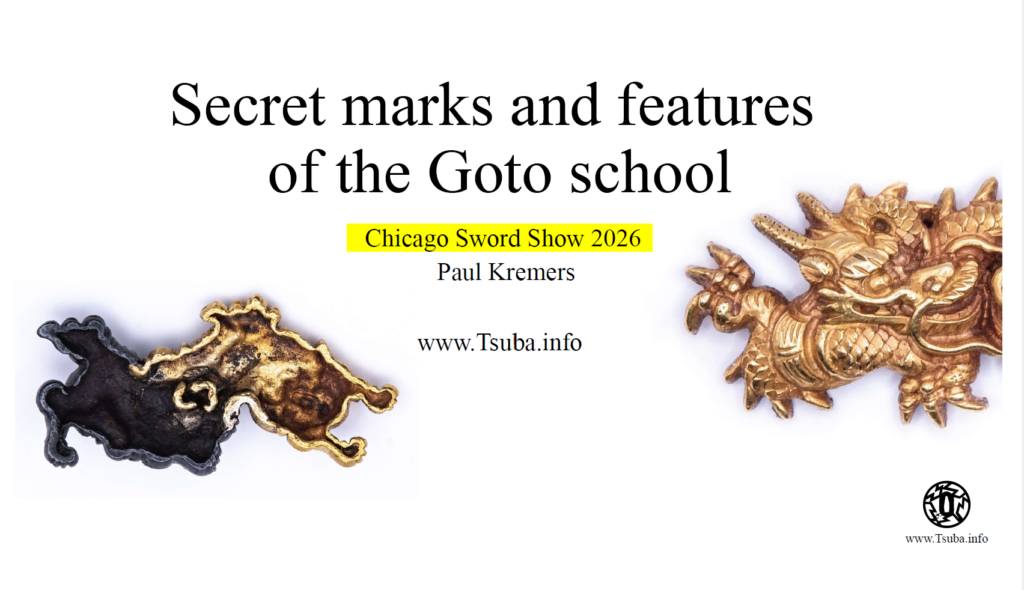
Over the course of seventeen generations, from the Muromachi period through the late Edo period, the Goto school played a defining role in the history of Japanese sword fittings and had a lasting influence on the aesthetics and standards of the field. Its works shaped the visual language of Tosogu for centuries and remain central to the study and appreciation of fine fittings today.
In his presentation Paul Kremers will explore how works of the Goto school can be identified and more precisely understood through close observation of stylistic and technical features. Particular attention will be given to the methods and artistic practices by which Goto pieces were marked, distinguished, and recognized, with specific hints to the identification of the earlier generations. The discussion will focus especially on works featuring shishi and dragons, as these motifs offer especially revealing examples of the school’s characteristic design vocabulary and craftsmanship.
Alongside historical and stylistic context, the presentation will also address practical questions of attribution. Which features are especially important when assessing whether a piece may be associated with the Gotō school? What kinds of workmanship and which secret signs may point toward a Goto origin? And conversely, how can we better understand pieces that appear related, yet should not be classified as Goto work?
Following the presentation, there will be time to examine pieces brought by participants. Attendees are warmly invited to bring their own fittings for discussion, so that we may look together for the presence or absence of these characteristic features and consider how such pieces might best be understood or classified. Especially welcome are pieces with shishi or dragon designs, as well as Kozuka with Nanako. Participants do not need to bring works that are necessarily attributed to the Goto school; pieces of similar style are equally welcome, since part of the discussion will be devoted to understanding why certain works resemble Goto pieces yet should be placed elsewhere.